Skip to content

JournalEvaluationNo. 10

What Signal-Based Outbound Really Costs: 5 Stacks Priced Line by Line

Five outbound stacks priced from public pricing pages for 500 contacts a month, with human time, plan limits and a free cost worksheet.

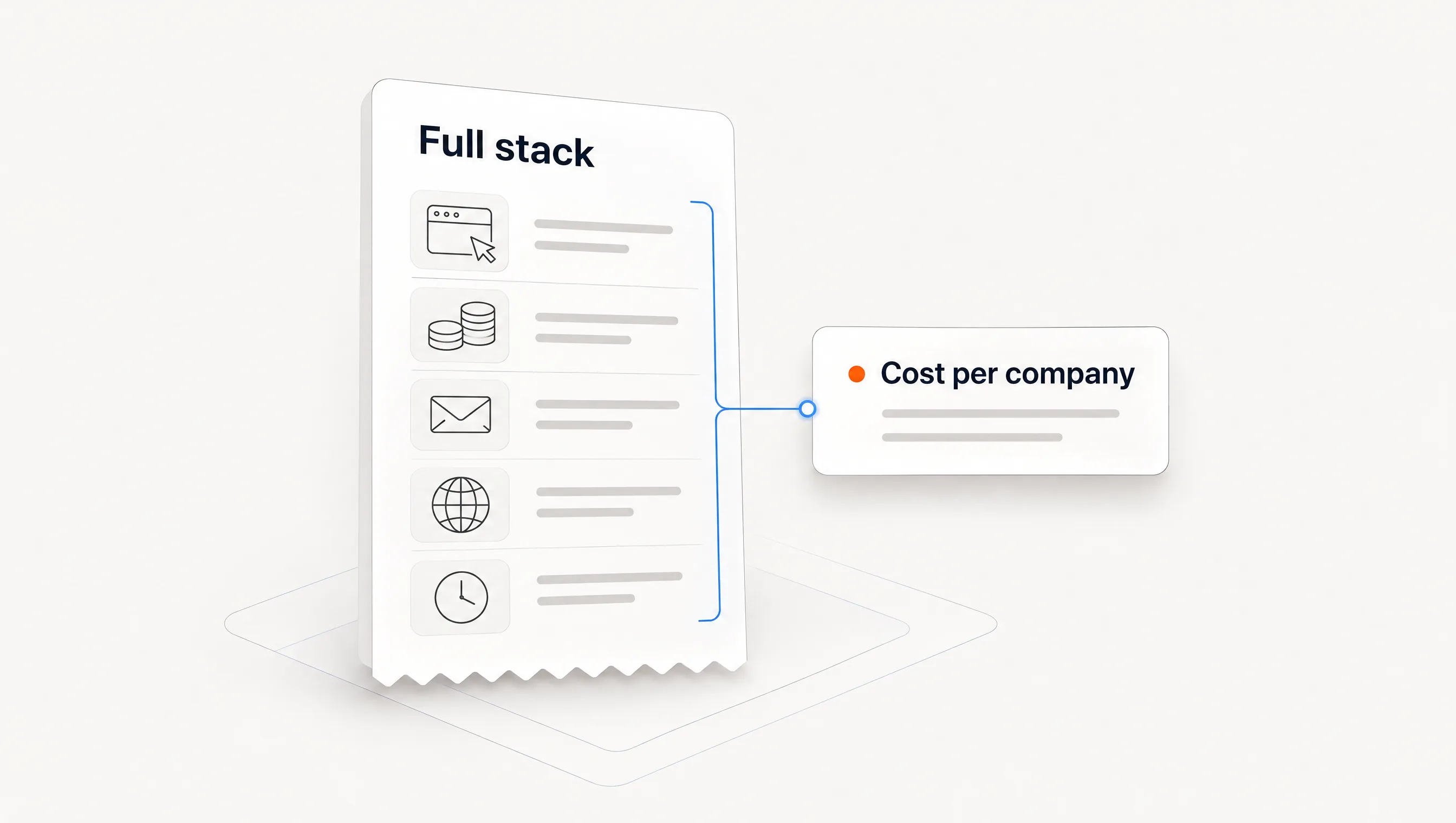
An itemized receipt of software, credits, mailboxes, domains and time adds up to a cost per company.
Contents
  1. 01The scenario we priced
  2. 02Five stacks, priced line by line
  3. 03What each stack does not include
  4. 04The cost of human time
  5. 05What breaks first as volume grows
  6. 06Cost per qualified company
  7. 07Download the worksheet
  8. 08Where Perpetual fits
  9. 09Frequently asked questions

Published by Perpetual

For 500 contacts a month, the five signal-based outbound setups priced here cost between about $60 and $272 a month in software and sending infrastructure, or $0.12 to $0.54 per contact. The $60 Unify line uses one mailbox, or about 68 sends per working day for this workload. The other stacks use three mailboxes, about 23 sends each. A $110 Unify scenario adds two mailboxes at $25 each, but requires vendor confirmation of plan eligibility. Those software differences are smaller than they look. At $50 an hour, every minute of human work per contact adds $0.83, so the time your team spends on each contact matters more than the subscription.

Perpetual publishes this breakdown and is one of the five setups. It is the most expensive on software alone in this scenario. List prices were read on each vendor's pricing page on November 10, 2026. The workload is our own assumption, and we have not measured how many hours each setup takes, so the hours are left for you to fill in.

The scenario we priced

A price comparison only means something against a fixed workload. We used one small-team case:

  • 500 contacts a month, with three emails each, for 1,500 sends.
  • One seller operating the system.
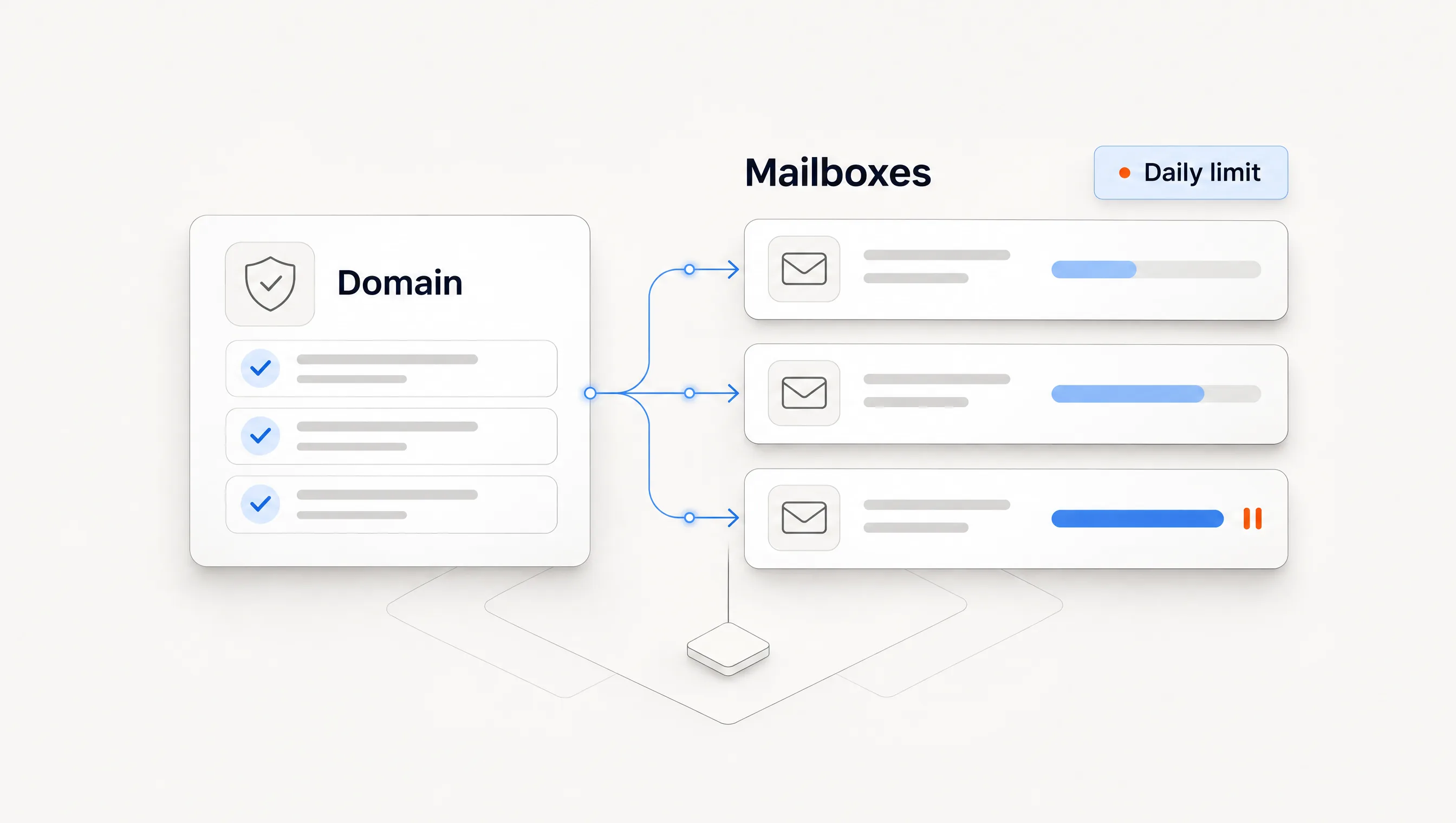
  • Three mailboxes on two sending domains for stacks A, B, C and E, roughly 23 sends per mailbox per working day over 22 days. Stack D uses one mailbox, roughly 68 sends per working day; these are workload calculations, not recommended sending limits.
  • Monthly billing wherever a vendor offers it.

Mailboxes use the Google Workspace Starter list price of $7 per user per month. Domains use the $13 per domain per year listed on Smartlead's pricing page, which is about $2.17 a month for two. Taxes, warm-up beyond what a plan includes, phone numbers, CRM fees and one-time setup are excluded.

Five stacks, priced line by line

StackLine itemsMonthly totalPer contact at 500
A. Sales Navigator and a sequencerSales Navigator Core $119.99, Smartlead Base $39, mailboxes $21, domains $2.17$182.16$0.36
B. Job data and an all-in-one senderTheirStack API $49, Instantly Starter bundle $94, mailboxes $21, domains $2.17$166.17$0.33
C. Clay and a sequencerClay Launch $185, Smartlead Base $39, mailboxes $21, domains $2.17$247.17$0.49
D. Unify, one seatUnify Pro $60, with 2,400 credits and one mailbox per seat$60.00$0.12
E. PerpetualPerpetual, 4,000 credits $249, mailboxes $21, domains $2.17$272.17$0.54

These totals do not buy the same work, which is the point of the next section. Stack D also runs on a single mailbox as listed. The Unify page checked November 10, 2026 lists managed mailboxes at $25 each under Business, while Pro includes one mailbox per seat. Adding two at that unit price gives $60 + 2 × $25 = about $110 a month, or $0.22 per contact. This is conditional arithmetic, not a confirmed Pro offer: ask whether those add-ons are available or a Business contract is needed. External mailbox and domain costs for Unify are not established here.

Prices for Apollo and ZoomInfo are missing because we could not read a price for either on their pricing pages that day. ZoomInfo sells through its sales team. Clay's page shows $167 and $185 for Launch; we used $185 because the gap matches its 10% annual discount and this scenario is monthly.

What each stack does not include

The cheapest line on a price table is not the cheapest way to get the work done. Check which jobs remain.

JobABCDE
Find hiring companiesYouData API, connected by youWorkflow you buildConfirm job-posting coverageIncluded
Qualify against your offerYouYouWorkflow you buildConfirm in a trialIncluded
Find the emailNot includedInstantly creditsData creditsCreditsIncluded
Write from the evidenceYouYou or your toolWorkflow you buildConfirm in a trialIncluded
Send and follow upSmartleadInstantlySmartleadIncludedIncluded

The table is based on vendor pages, and “confirm” means we could not establish that specific job from what we read. Stack A does not include an email source at all, so its true cost is higher once you add one.

The line most comparisons leave out: human time

The arithmetic is simple. At an assumed $50 an hour, one minute per contact costs $0.83. At 500 contacts, one minute each is 8.3 hours and about $417 a month.

Human minutes per contactHours for 500 contactsAdded cost at $50 an hourAdded cost per contact
0.54.2$208$0.42
18.3$417$0.83
325$1,250$2.50
650$2,500$5.00

That gives you a break-even you can use. Stack E costs $0.42 more per contact than stack D and $0.18 more than stack A. Thirty seconds of human work per contact equals the first gap, and about 13 seconds equals the second. The reverse is equally true: if a pricier stack does not actually remove that much work, you are paying for nothing. Measure review and repair time, not only the steps that were automated.

Replace $50 with your own loaded hourly cost. For a founder doing outreach, the honest number is often what that time could earn elsewhere.

What breaks first as volume grows

Plan limits turn a flat comparison into a step function. Here is what happens at 2,000 contacts a month with the same three emails, or 6,000 sends.

StackFirst limit at 2,000 contactsWhat it means
ASmartlead Base's 2,000 contacts and 6,000 sendsExactly at the ceiling. Hand research across 2,000 companies gives out long before this.
BInstantly Starter's 1,000 uploaded contacts and 5,000 emailsMove to Scale at $194 a month.
CClay Launch's data credits2,500 to 3,000 credits at 500 contacts allows 5 to 6 per contact. At 2,000 it allows 1.25 to 1.5, so expect add-ons or Growth.
DUnify Pro's 2,400 credits and single mailboxAdd seats, credits or mailboxes depending on your use.
E4,000 credits covers up to 800 ready contacts2,000 ready contacts can use 10,000 credits: the 8,000-credit plan at $449 plus a 2,000-credit pack at $124.50, or $573.50.

Sending 6,000 emails also needs more mailboxes. Whatever your per-mailbox limit is, add those seats before comparing.

Turn cost per contact into cost per qualified company

Cost per contact flatters a stack that contacts the wrong companies. Divide by the share of researched companies that truly qualify.

As an invented example, $0.50 per contact at a 50% qualification rate is $1.00 per qualified company, and at 20% it is $2.50. Those rates are illustrative, not benchmarks. Billing rules matter here too. In Perpetual, a company that does not qualify uses no credits, though the subscription is charged either way. In other products, check whether failed enrichment or rejected rows still consume credits.

Then carry the figure through to the result you care about, as our signal-based outbound scorecard explains. A low cost per contact is of little use if no qualified meetings are held.

Download the stack cost worksheet

Download the signal-based outbound cost worksheet (CSV). It lists every line above with its source and check date, and leaves empty columns for your quotes, hours and hourly cost. It contains values, not formulas, so recheck each price before relying on it.

Where Perpetual fits

Perpetual is priced for the case where company research, contact selection, verified email and a first message should arrive together. A ready contact uses up to 5 credits: 1 for company research and qualification, 1 for the selected person, 2 for a verified email and 1 for a validated first message. Sending, follow-ups and reply tracking use no credits. Usage billing is currently in preview, as the pricing page notes, and the subscription is still charged.

If you already have accounts, contacts and copy, a sequencer costs less and may be all you need. Perpetual needs a Google Workspace mailbox, and it has no free plan. If you are budgeting from scratch, our guide to affordable pipeline tools for bootstrapped startups covers cheaper starting points.

Frequently asked questions

How much does signal-based outbound cost for a small team?

In this scenario, about $60 to $272 a month in software and sending infrastructure for 500 contacts, before human time. The $60 Unify case covers one mailbox at about 68 sends per working day; three mailboxes would be about $110 if two $25 add-ons are available on that plan. The page places managed mailboxes under Business, so confirm the quote. The other stacks assume about 23 sends per mailbox per working day. Your total depends on what each tool leaves undone and how many hours your team spends on it.

Why are the setup hours not filled in?

We have not timed these tools on a shared workload, and any number we printed would be a guess. The worksheet has a column for your own measurement.

Why not use annual pricing?

Monthly pricing keeps the comparison free of a commitment that many small teams would not make during a test. Annual billing lowers several of these lines, including Perpetual's, to $199 a month.

Do these prices include everything?

No. They exclude taxes, add-ons not listed here and one-time setup. They are list prices on the date above, and a vendor quote can differ.
Keep reading47 more
01

How Staffing Agencies Find Clients Using Job Postings

Find staffing agency clients through job postings: which roles to pursue, who owns the hire, what to say first, and a free client research sheet.

Research8 min read
02

How to Build an ICP for B2B Outbound, Even With Few Customers

Build an ICP for B2B outbound as a testable hypothesis, even with few customers. Criteria, persona, unknown data and a free ICP worksheet.

Research7 min read
03

How to Scale Cold Email Without Burning Your Domain

Scale cold email without burning your domain: Google, Yahoo and Microsoft rules, mailbox ramp-up, sending caps, stop rules and a free planner.
Outreach7 min read
04

Unify Alternatives: 6 Options Compared on Price and Fit

Compare six Unify alternatives on price, fit and sending model, with Unify's own pricing checked November 16, 2026, and when to stay with it.

Evaluation6 min read
05

Pipeline Generation Tools: How to Choose by the Job You Need Done

Five types of pipeline generation tools, the outbound steps each covers, how to find your bottleneck and a 30-account pilot worksheet.

Evaluation7 min read
06

Intent Data Tools: 4 Source Types and How to Test Them

Compare intent data tools by source: first-party, publisher co-op, review site and public events. Includes a 25-account accuracy test worksheet.

Signals7 min read
07

The GTM Tech Stack for a Small B2B Team, Stage by Stage

Which go-to-market tools a small B2B team needs at each stage, what to skip, and how to audit handoffs. Includes a free stack audit worksheet.

Evaluation6 min read
08

Account Discovery vs. Account Monitoring: Which Do You Need?

When to find new accounts and when to watch the ones you own, how to split seller capacity between both, and a weekly routine with a free worksheet.

Signals6 min read
09

Best Hiring Signal Tools for B2B Sales: 6 Options Compared

Compare six hiring signal tools by source, published price and the work each leaves to your team. Includes a free 20-company test worksheet.

Evaluation9 min read
11

Clay Alternatives for Teams Without a GTM Engineer

Choose a Clay alternative by the job you need done. One hiring workflow mapped across five options, plus when you should stay with Clay.

Evaluation7 min read
12

What 2,039 Job Postings Tell Sellers, and What They Can't

Original data from 2,039 public job postings: 14% of rows were duplicates, and 97.6% of vacancy motives remained unknown. Methods and limits explained.

Research8 min read
13

Signal Stacking for B2B Sales: 5 Plays You Can Build

Combine independent buying signals into a clear account decision. Five practical plays, a worked example and a free signal-stacking CSV worksheet.

Signals9 min read
14

How to Find Decision-Makers Using Hiring Signals

Use job responsibilities and reporting lines to find a relevant first sales contact. Includes six scenarios, three examples and a free contact-selection matrix.

Research9 min read
15

How to Find Companies Hiring RevOps Leaders

Find and qualify companies hiring RevOps leaders through current job postings. Reusable searches, mandate checks and a free prospecting worksheet.

Research8 min read
16

AI SDR vs. Sales Automation: What Does Your Team Need?

Compare AI SDRs and sales automation across eight outbound jobs, operating cost and human ownership. Includes a four-week pilot and a free CSV worksheet.

Evaluation10 min read
17

Best Buying Signal Tracking Platforms in 2026: How to Compare Them

Compare buying signal platforms by account events, people changes, topic intent and workflow tools, with a checklist and a two-week test.

Evaluation9 min read
18

What Is Signal-Based Prospecting? Definition, Six Signals and a Weekly Workflow

What signal-based prospecting is, six signals to track, what each cannot prove, and a weekly workflow from observation to grounded outreach.

Signals8 min read
19

AI-Powered Go-to-Market Platforms for B2B SaaS Pipeline Generation: What to Compare

Compare AI GTM platforms for B2B SaaS: four categories, limits on AI decisions, sending controls and questions to ask before buying.

Evaluation7 min read
20

Sales Intelligence Tools for B2B Teams With Long Sales Cycles

What to look for in sales intelligence tools when deals take months: change tracking, history, multiple contacts, re-open triggers and a 90-day test.

Evaluation8 min read
21

12 Buying Signal Examples and What to Do Next

A practical buying-signal library: what each observation supports, what remains unknown, and the next step to take. Includes a free CSV worksheet.

Signals8 min read
22

How to Use Hiring Signals for Sales Prospecting

Turn public job postings into a focused prospecting play: check account fit, verify the evidence, find the responsible person and write a relevant opener.
Research8 min read
23

4 Signal-Based Cold Email Templates You Can Adapt

Original cold email templates for relevant hiring, new responsibilities, expansion and useful follow-ups. Includes source checks and a free CSV download.
Outreach7 min read
24

How to Measure Signal-Based Outbound: A Campaign Scorecard

Measure account selection, positive replies, qualified meetings held and total cost with clear denominators. Includes a free account-level CSV worksheet.

Research8 min read
25

Job Postings as Buying Signals: What They Tell You

Which job postings matter for which offer: clustered roles, a first hire in a new function or a reposted role, and what a posting does not prove.

Signals10 min read
26

Hiring Signals vs. Intent Data: What Each Shows

Where hiring signals and third-party intent data come from, how fresh and checkable each is, and when to use one, the other or both.

Signals9 min read
27

How to Find Companies Hiring SDRs (and When to Reach Out)

Find companies hiring SDRs on careers pages, job boards and LinkedIn Jobs, judge each posting, and decide whom to email and when.

Research9 min read
28

CRM vs. Dedicated GTM Automation Platform: Which Do You Actually Need?

Compare CRM and GTM automation by the work each owns, the gaps in your stack and the integration rules that connect them.

Evaluation8 min read
29

How to Evaluate a GTM Automation Vendor's Approach to Intent Signals

A checklist for evaluating how a GTM automation vendor sources, qualifies and acts on intent signals, and how to test it on your own data before you buy.

Evaluation7 min read
30

Using Signal Data to Optimize Paid Acquisition Campaigns

Use conversion values, clean events, B2B pipeline stages and account observations to guide paid acquisition and targeting.

Signals8 min read
31

When to Bring In CRM and GTM Integration Experts

When to hire CRM and GTM integration help, which specialist fits the problem, and what to settle before bringing one in.

Evaluation6 min read
32

Account Data Management: What Sales Teams Should Evaluate Before Buying

Evaluate account data software with checks for accuracy, freshness, ownership, integration, missing data and change tracking.

Evaluation6 min read
33

Signal-Based Prospecting for Enterprise RevOps Teams With Complex Deal Cycles

How enterprise RevOps teams use buying signals to reach accounts before the RFP, keep them out of open deals, reach the buying group and measure pipeline.

Signals8 min read
34

How to Automate Acting on Buying Signals to Move Deals Forward

How to automate acting on buying signals: a playbook per signal type, what stays human, routing, drafting from evidence and a four-week rollout.

Outreach8 min read
35

Real-Time Buying Signal Detection: How to Evaluate Go-to-Market Platforms That Make It Core

What real-time buying signal detection means per signal family, how fresh each should be, and how to tell a core capability from a bolt-on feature.

Signals8 min read
36

Go-to-Market Platforms That Integrate With Your CRM and Marketing Automation: What to Check Before You Buy

Evaluate GTM integration with your CRM and marketing tools: field ownership, read and write rules, suppression and a one-week test.

Evaluation8 min read
37

Sales Automation Platforms With Fast Implementation: How to Get Live in Weeks, Not Quarters

What makes sales automation slow to implement, what fast implementation looks like, questions to ask before you sign, and a four-week plan to go live.

Evaluation6 min read
38

Revenue Automation Platforms for Mid-Market Teams Pursuing Continuous Opportunity Discovery

A practical guide to revenue automation platforms that help mid-market teams find opportunities continuously, act on signals, and move deals forward.

Evaluation3 min read
39

Unified Go-to-Market Platforms: Combining Signal Detection and Deal Progression

What unified go-to-market platforms are, how they combine signal detection with deal progression, and what to look for when evaluating them.

Signals3 min read
40

Affordable Signal-Based Pipeline Generation Tools for Bootstrapped Startups

Compare manual watchlists, TheirStack, Unify and PredictLeads with checked entry prices, limits and the work a startup still needs to do.

Evaluation4 min read
41

Migrating From Manual Prospecting to an Automated Signal-Based Go-to-Market System

How to move from manual prospecting to an automated signal-based go-to-market system: what changes, the stages, the data work and the pitfalls.

Signals3 min read
42

Choosing go-to-market automation for a small sales team with no ops function.

A small team needs fewer moving parts, not more dashboards. Four questions to decide what to automate and what to keep in human hands.

Evaluation3 min read
43

Signal-based prospecting for startups that need predictable pipeline.

Volume outbound makes pipeline feel random. Prospecting against observable buying moments gives a startup a steadier rhythm, if the signals are checked first.

Signals3 min read
44

Tools That Help Sales Development Teams Prioritize High-Intent Accounts Without Manual Research

Evaluate SDR tools by the research they remove, the evidence behind account rankings, contact quality and the work left for your team.

Evaluation4 min read
45

Evaluating Customer Support and Track Record in Signal-Based Sales Platforms

How to evaluate customer support and track record when you compare signal-based sales platforms, from reference calls to CRM sync and time-to-first-signal.

Signals13 min read
46

A signal is not a buying intent.

A new hire tells you something changed. It does not tell you someone is ready to buy. Better outbound starts with that distinction.

Signals2 min read
47

What belongs in a lead brief?

The source, the change, the timing, and the unanswered question. A small brief that makes an outbound decision easier to review.

Research2 min read
48

Write the question before the pitch.

A practical way to turn account research into an opener that earns a conversation without overstating what you know.

Outreach2 min read

Put your GTM in perpetual motion.

Get started

Sending stays within the limits you set, and you can pause it any time.

Signal-Based Outbound Cost: 5 Stacks Priced